
There’s a very specific kind of betrayal that happens when you open the fridge on a Wednesday, reach for the container you portioned out on Sunday, and find it’s either gone, moved to a shelf you didn’t leave it on, or mysteriously missing two servings you definitely didn’t eat.
I’ve lived with roommates for six years across four different apartments. The fridge has been the single biggest source of low-grade conflict in every single one of them. Not rent. Not dishes. The fridge.
Most meal prep advice assumes you’ve got a fridge entirely to yourself, with unlimited shelf space and nobody else’s ranch dressing taking up the door. That’s just not the reality for a lot of people. Students, young professionals splitting rent, anyone in a shared house.
So here’s what I’ve actually learned, roommate by roommate, apartment by apartment, about making meal prep work when a quarter of the fridge is technically yours and the rest is a shared negotiation.
The Shelf Wars, Apartment One
My first shared apartment had a fridge that was, generously, the size of a large dorm fridge, split between three people.
I didn’t think about this at all before I moved in. I just started meal prepping the way I had at home. Five full containers, taking up an entire shelf, no conversation with anyone about it.
What Went Wrong
Within a week, my roommate Priya had moved my containers to the door shelves to make room for her own groceries, without telling me. Two of them tipped over from the door’s constant swinging motion. I came home to a fridge that smelled like spilled teriyaki chicken and a roommate who felt just as blindsided as I did, because from her side, I’d taken up unreasonable space without ever discussing it.
That was the first real lesson. Shared fridge space isn’t first come, first served, even if it feels that way when you’re the one who meal prepped first. It’s a negotiation, whether anyone explicitly has that conversation or not.
Jake and the Great Label Standoff
Apartment two, I lived with a guy named Jake who had a habit of eating anything in the fridge that didn’t have an obvious owner. His logic was simple: if it’s not labeled, it’s fair game.
This led to him eating an entire container of chicken and rice I’d prepped for the week. Twice. It took me a while to even figure out what was happening.
The Labeling Experiment
I started labeling everything with masking tape and a Sharpie: name, day, contents. Jake’s response was to start eating things that were labeled anyway, arguing that a label wasn’t a legally binding contract.
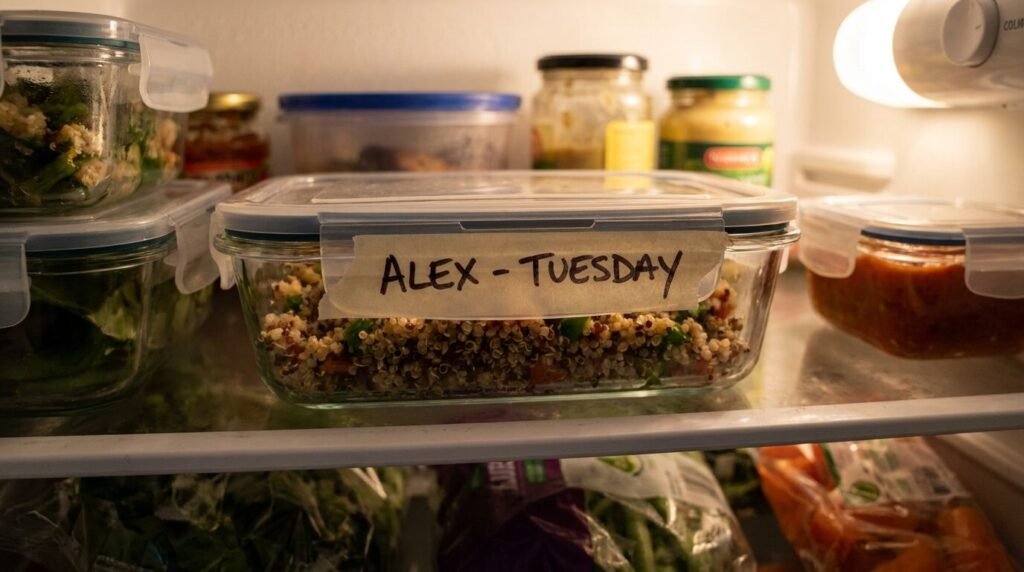
We never fully resolved that philosophically. What did work was switching from vague labels like “chicken bowl” to something more specific and slightly guilt-inducing, like “Sarah’s lunch for Thursday, please don’t.” It sounds silly, but a label that names a specific day and a direct request got respected more often than a generic one ever did.
The Real Fix Wasn’t the Labels
The bigger fix wasn’t the labeling at all. It was having an actual conversation in our group chat, which we ran through a regular iPhone Messages thread, about which shelf was whose.
We set a norm that unlabeled communal stuff was fair game, but labeled individual stuff wasn’t. Having that rule stated once, explicitly, did more than any label ever could.
The Subletter Situation
Apartment three came with a summer subletter for two months while one of my actual roommates was out of the country. This was, without question, the worst meal prep stretch of my life.
A temporary person has zero investment in maintaining any system that existed before they arrived.
The Fridge Reorganization
She reorganized the entire fridge on day one without asking anyone. My carefully portioned Sunday containers ended up shoved into the back of the bottom shelf, behind her oat milk. I didn’t find them again until they’d already gone bad.
I lost an entire week of prepped food, which felt like both a financial hit and a personal one, given how much effort had gone into that Sunday prep session.
What I Learned From It
With anyone new in a shared space, even temporarily, it’s worth having a five minute conversation on day one about fridge zones, before any assumptions get made in either direction. I don’t do this proactively with long-term roommates anymore, since we’ve usually settled into an understanding. But with anyone new or temporary, that conversation happens immediately now, not after something goes missing.
What Actually Works Now, Four Roommates and Four Fridges Later
My current apartment has three roommates and a genuinely small fridge for four adults. This is the system that’s held up for almost two years without a single major incident.
Fixed Shelves, Shared Space
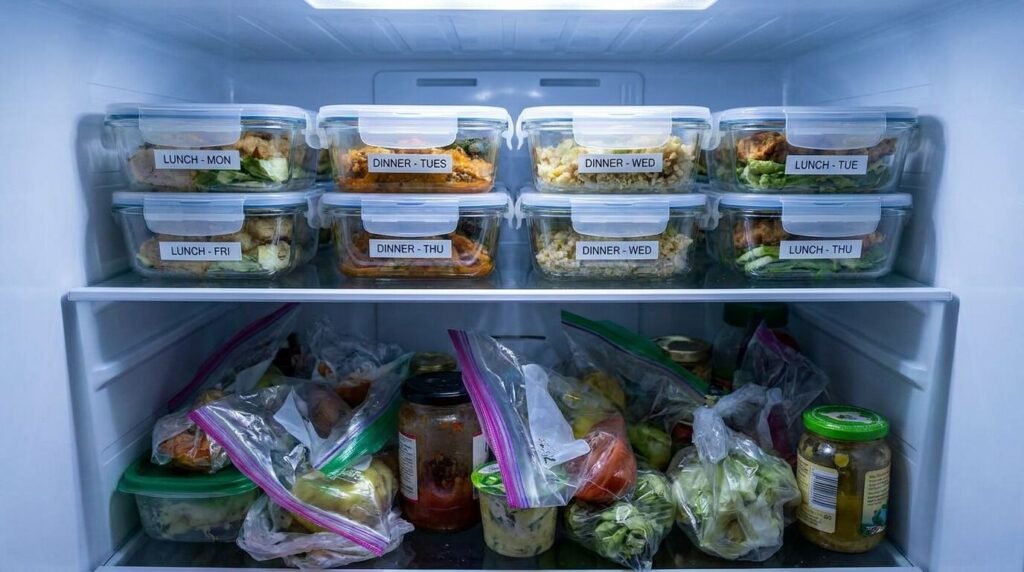
We each get one shelf, full stop, agreed on when whoever moves in first claims it. It’s treated as fixed unless someone explicitly asks to trade. The door and crisper drawers are shared space for condiments, produce, and anything nobody’s precious about.
Smaller Containers, Smaller Batches
Within my own shelf, I use stackable glass containers specifically because they let me fit more into a smaller footprint than the wider plastic ones I used to use. Switching from bulky rectangular containers to ones designed to stack directly on top of each other probably doubled how much I can actually fit into one shelf.
I also prep smaller batches more often instead of one giant Sunday cook up. Instead of five days of food taking up the whole shelf at once, I’ll do two or three days at a time and refill midweek. It means slightly more frequent cooking, but it also means I’m never the person whose five containers are hogging obvious space that someone else is quietly resenting.
The Whiteboard System
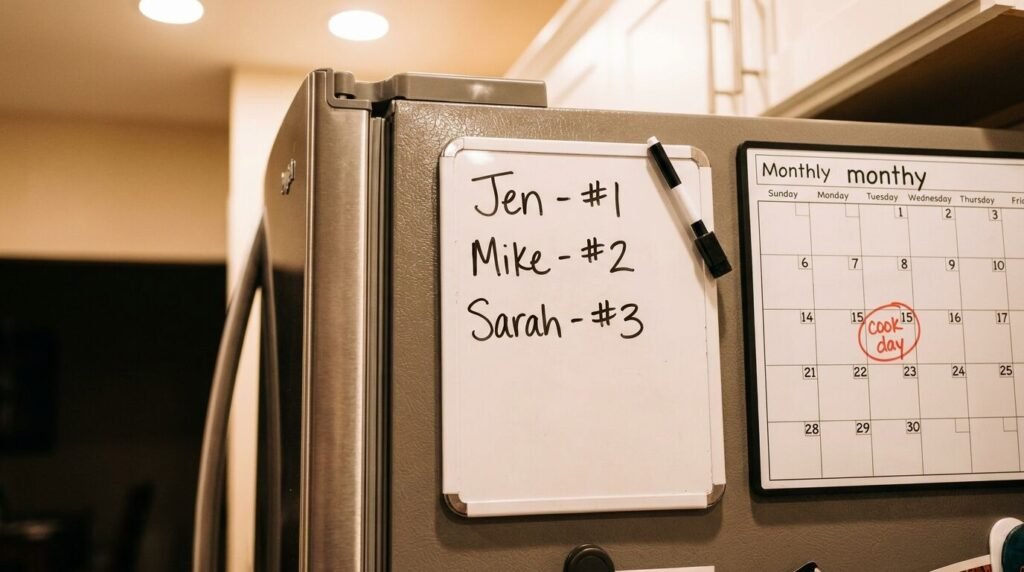
We keep a small dry erase whiteboard stuck to the side of the fridge with everyone’s name and their shelf number. It sounds unnecessary until you’ve had a new subletter or a visiting friend staying over who genuinely doesn’t know the unwritten rules yet. It’s a two second glance instead of a conversation that has to happen every single time someone new is in the kitchen.
The Small Details That Made a Bigger Difference Than I Expected
A magnetic whiteboard calendar on the fridge door, where we each write which day we’re planning to cook a big batch, has cut down on the “wait, why is the fridge completely full” surprise significantly.
It’s a tiny thing, but knowing Tuesday is someone else’s cooking day means I plan my own prep around it instead of both of us competing for stove and fridge space on the same evening.
I also started keeping one or two backup meals that don’t need the fridge at all. Shelf-stable stuff like a jar of good peanut satay sauce and rice noodles, or canned beans and rice, specifically for weeks when fridge space is unusually tight because someone else just did a big shop.
If you’re building out that kind of pantry-based backup rotation, the 10-minute egg fried rice I make on empty-fridge nights actually works surprisingly well here too, since it barely needs fresh ingredients at all.
Four Fridges Later
I won’t pretend this is a fully solved problem. Even with a good system, someone occasionally forgets whose shelf is whose, or a new roommate takes a month to actually absorb the unwritten rules the rest of us have had years to build.
But the difference between apartment one, where I lost food constantly and quietly resented everyone about it, and now, where I genuinely don’t think about the fridge as a source of conflict anymore, comes down almost entirely to one thing. Treating it as shared territory that needs actual agreements, not just my own meal prep plan dropped into a space I assumed was mine.
If you’re moving into a shared place for the first time, that conversation on day one will save you more frustration than any container or labeling system ever will.